Sole Trader vs Limited Company: Which Is Right for You?
Written and reviewed by Zoe, Managing Director at Kernow Accountancy : our family-run Helston practice has been advising Cornish sole traders, landlords and small businesses since 2011.
It’s one of the first big decisions anyone starting a business has to make. Here’s how sole trader and limited company compare for 2026/27, and where the tipping point usually sits.
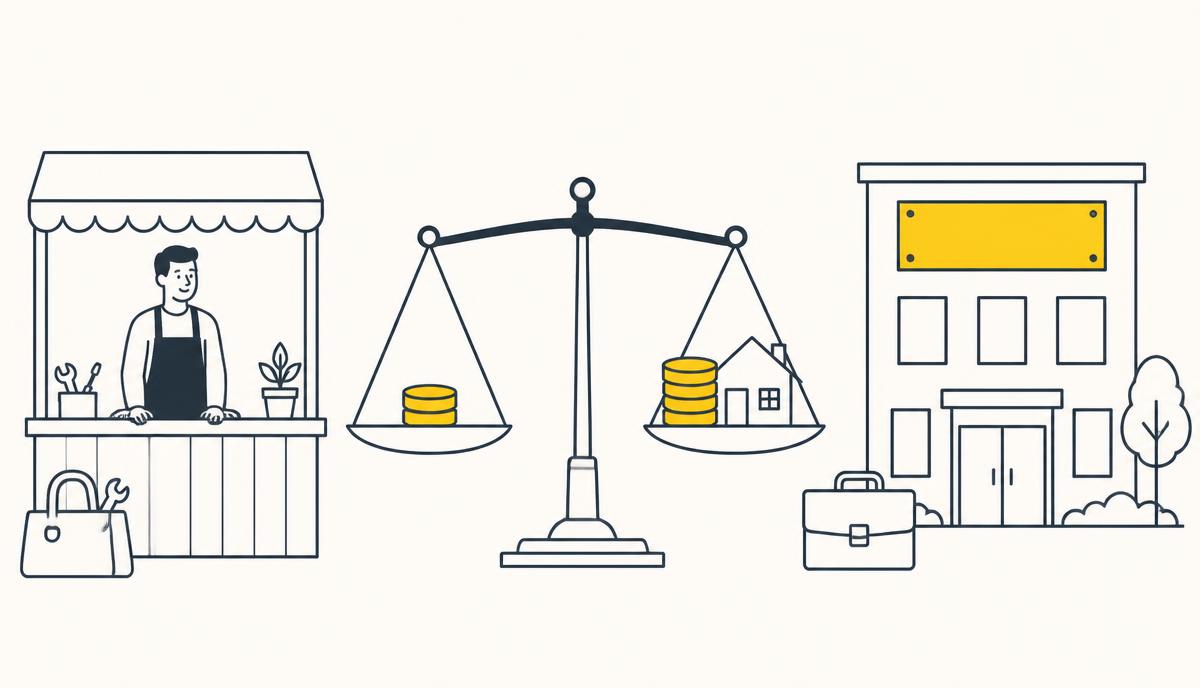
It is one of the first big decisions anyone starting a business has to make, and one that keeps coming back up as the business grows: should you trade as a sole trader, or set up a limited company? There is no single right answer. It depends on your profit level, your appetite for admin, and what you are trying to protect. Here is how the two compare for 2026/27, and a rough guide to where the tipping point usually sits.
The short version
Sole trader means you and the business are legally the same entity. It is simple to set up, easy to run, but you carry unlimited personal liability and pay Income Tax plus National Insurance on all your profit. New to it all? Our sole trader guide covers the basics.
Limited company creates a separate legal entity. It offers liability protection and can be more tax efficient once profits grow, but it comes with more admin, more cost, and less flexibility around how and when you access your money.
As a rough rule of thumb, the financial case for incorporating tends to strengthen once profits reach somewhere around £40,000 to £50,000 a year, though liability protection and credibility can make it worth considering earlier, regardless of profit.
How the tax actually compares
Sole trader
As a sole trader, all your business profit is treated as your personal income. You pay:
| Tax | Rate (2026/27) |
|---|---|
| Income Tax | 20% basic rate, 40% higher rate, 45% additional rate, on profit above your Personal Allowance (£12,570) |
| Class 4 National Insurance | 6% on profits between £12,570 and £50,270, then 2% above £50,270 |
| Class 2 National Insurance | Now voluntary for most sole traders, at £3.65 a week. Worth paying if you want to protect your State Pension record and your profits are below the threshold where it is credited automatically |
There is no separation between business money and your money. Everything is taxed as it is earned, whether you draw it out of the business or leave it sitting in a business bank account.
Limited company
A limited company pays Corporation Tax on its profits, and you then decide how to extract money for yourself, typically a mix of salary and dividends.
Corporation Tax (2026/27):
- 19% on profits up to £50,000 (the small profits rate)
- 25% on profits over £250,000 (the main rate)
- Profits in between are taxed on a sliding scale via marginal relief, giving an effective rate that rises gradually from 19% to 25% (for example, around 22% on £150,000 of profit)
Extracting money as salary and dividends:
- A small salary, often set around the National Insurance threshold, is usually paid first, as it is a deductible business expense and can be paid with little or no personal tax or NI
- The rest is typically taken as dividends, taxed after a £500 tax free dividend allowance, then at 10.75% (basic rate), 35.75% (higher rate), or 39.35% (additional rate)
- The company also pays employer's National Insurance at 15% on salary above the £5,000 secondary threshold, though single director companies with no other employees usually cannot claim the Employment Allowance that offsets this for other small employers
The key point: profit is taxed twice in a limited company structure, once as Corporation Tax on the company's profit, and again as dividend tax when you take money out personally. This is why the comparison is not as simple as "Corporation Tax is lower than Income Tax". It depends how much you actually need to draw out versus leave in the business.
A worked example (illustrative only)
Two businesses each make £60,000 profit in a year.
Sole trader, drawing all £60,000: pays Income Tax and Class 4 NI on the full amount as it is earned. There is no way to defer or reduce this by leaving money in the business.
Limited company, taking a small salary plus dividends, drawing all £60,000 out personally: pays Corporation Tax on the company's profit, then dividend tax on what is extracted. The company route often comes out slightly ahead at this profit level if all the money is drawn out, and further ahead if some profit is left in the company rather than withdrawn, since undrawn profit is not taxed as personal income at all until it is.
The gap tends to widen as profits grow past this point, particularly if you do not need to draw out every pound the business makes. An accountant can run the actual numbers against your specific income, expenses and drawing needs; this is one comparison worth getting modelled properly rather than estimated.
Liability: what happens if things go wrong
This is the part that is easy to overlook when you are focused on tax.
Sole trader: you and the business are the same legal entity, which means unlimited personal liability. If the business runs into debt, is sued, or fails, your personal assets, your house, savings, car, can be at risk to settle business debts.
Limited company: the company is a separate legal person. In most circumstances, your liability is limited to what you have invested in shares, so your personal assets are protected if the company gets into difficulty. This protection is not absolute: if you have given a personal guarantee on a loan or lease, or engaged in fraudulent or wrongful trading, that protection can be pierced.
If your work carries meaningful financial or legal risk, large contracts, potential for disputes, or debt funded growth, this alone can be reason enough to incorporate, even before the tax numbers tip in your favour.
Admin and cost
| Sole trader | Limited company | |
|---|---|---|
| Setup | Free HMRC registration, takes minutes | Companies House registration, small one off fee |
| Annual filings | One Self Assessment return | Annual accounts, Confirmation Statement, Corporation Tax return, plus your own Self Assessment if you take dividends |
| Payroll | Not usually needed | Needed if you take a salary |
| Public record | No | Company accounts are public |
| Accountancy fees | Typically lighter, often in the low hundreds annually | Typically several times higher, to stay compliant |
Credibility and growth
Some clients, particularly larger businesses and public sector organisations, prefer or require working with limited companies. Trading as a limited company can also make it easier to bring in co-founders or investors through shares, build a company pension strategy, and separate the business's identity from your own name.
For a lot of small, service based businesses this does not matter much day to day. But if you are aiming to scale, bring in a business partner, or work with corporate clients, it is a factor worth weighing alongside the tax position.
Which should you choose?
As a general guide:
Sole trader tends to suit you if:
- You are just starting out or testing an idea
- Profits are modest (roughly under £40,000 to £50,000)
- Your work carries low financial or legal risk
- You want minimal admin and the lowest running costs
- You plan to draw out most or all of the profit each year anyway
Limited company tends to suit you if:
- Profits are consistently higher, or growing quickly
- You want to leave some profit in the business rather than drawing it all out
- Liability protection matters for your type of work
- You want to bring in a co-founder or investor, or build a longer term company pension strategy
- Credibility with corporate or public sector clients matters
Can I switch later?
Yes. Plenty of businesses start as sole traders and incorporate once profits justify it. Moving from sole trader to limited company involves transferring the business (and sometimes its assets) into the new company, registering with Companies House and HMRC, and closing out your sole trader Self Assessment position for that business. It is a well trodden process, but it is worth planning with an accountant rather than doing it retroactively after a big tax year, since timing can affect the outcome. If Making Tax Digital is also on your radar, our MTD guide explains what is changing and when.
Key takeaways
- Sole traders pay Income Tax and National Insurance on all profit; limited companies pay Corporation Tax, with a further layer of tax when profit is extracted as salary or dividends.
- The financial case for incorporating generally strengthens from around £40,000 to £50,000 profit upward, especially if you do not need to withdraw all of it.
- Limited companies offer liability protection that sole traders do not have, a factor worth weighing beyond the tax numbers alone.
- Admin and accountancy costs are meaningfully higher for limited companies, which can outweigh tax savings at lower profit levels.
- You can switch from sole trader to limited company later; it does not have to be decided once and for all on day one.
Not sure which fits your numbers?
The right answer depends on your actual profit, how much you need to draw out to live on, and how much risk your work carries, not a rule of thumb. If you would like us to run the real numbers for your situation and tell you plainly which structure comes out ahead, get in touch with the team at Kernow Accountancy.
This article is for general guidance and reflects UK tax rules as of 2026/27. It is not a substitute for advice tailored to your specific circumstances; speak to your accountant before making decisions based on it.